
Wearable Signals: What They Reveal
Wearables are the lifeblood of digital patient twins. They provide a rich, continuous stream of signals that paint a picture of your metabolic state and daily habits. Different devices capture different aspects of your health, and together they give the twin a 360° view of you. Here are some key examples and what they tell us:
- Continuous Glucose Monitors (CGMs): For people with diabetes, CGMs are game-changers. These sensors sit on your skin and read your blood sugar every few minutes. Feeding this data into a digital twin lets it see patterns and even forecast your glucose levels. If your twin notices your blood sugar trending up, it can warn of a coming spike and suggest an insulin adjustment or a quick walk to bring it down. Conversely, if levels are dropping, it might prompt you (or your doctor) to head off a low with a snack or lower insulin dose. Essentially, a CGM-powered twin doesn’t just reflect your current sugar level – it looks ahead an hour or two and helps prevent those dangerous highs or lows before they happen.
- Activity and Heart-Rate Trackers (e.g., Fitbit): Devices like smartwatches, fitness bands, or chest strap monitors record your physical activity and vital signs like heart rate. This data is gold for understanding how your body responds to exercise, stress, and daily activities. For instance, a spike in heart rate during a meeting might indicate stress, while sustained lower heart rate overnight indicates good recovery. When your digital twin ingests step counts, exercise duration, and heart-rate trends, it learns how these factors impact things like your glucose metabolism. Maybe it notices that on days you take 10,000 steps, your blood sugar stays more stable, or that intense exercise causes a short-term glucose rise followed by improved insulin sensitivity. By recognizing these links, the twin can adjust its predictions – say, expecting a lower glucose level tonight because you went for a long walk this afternoon.
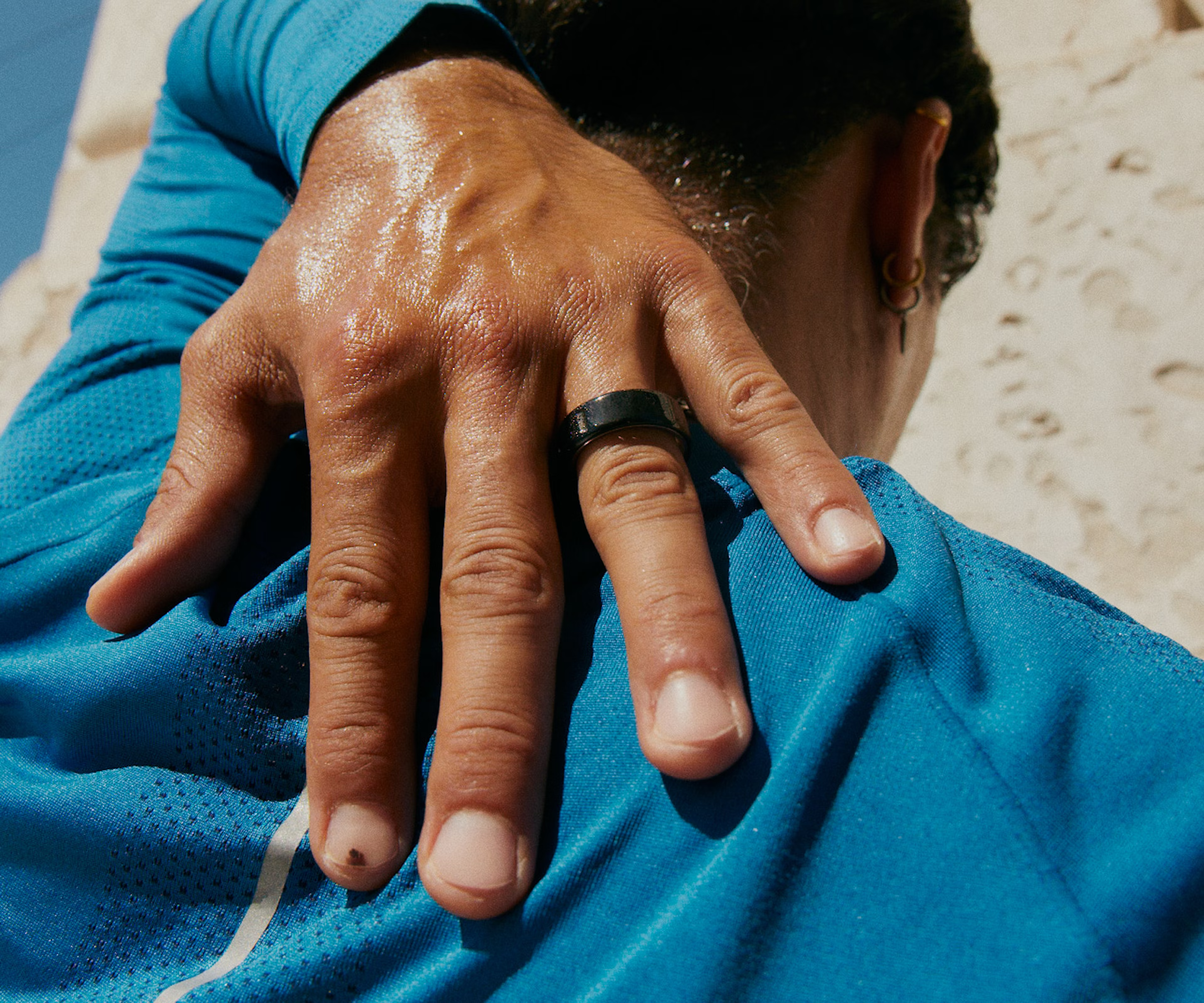
- Sleep and Recovery Trackers (e.g., Oura Ring): Sleep is a critical piece of the health puzzle, and wearables like the Oura Ring specialize in tracking it. The Oura Ring (worn on your finger) monitors your sleep quality, stages (deep, REM, light sleep), nighttime heart rate, and even your body temperature trends. These metrics tell the twin how well your body recovered and rested. Why does this matter in endocrinology? Because poor sleep or high stress can throw off your metabolism and hormone levels. For example, if your Oura Ring shows you had a restless night and an elevated resting heart rate (signs you’re not fully recovered), your digital twin might predict that your blood sugar will run higher than usual or that you’ll be less responsive to insulin. On the flip side, consistently good sleep data would inform the twin that your body is primed to handle the day. By incorporating sleep and recovery info, the twin model becomes much more personalized. It knows, for you specifically, how a bad night’s sleep affects your diabetes management the next day, and it can adjust recommendations accordingly.
- Nutrition Logs and Other Lifestyle Data: Not all useful data comes from wearable hardware; some comes from apps or manual input. Logging your meals, calories, or even hydration can provide context that wearables alone might miss. If you note that you had a high-carb dinner or your calorie count spiked on the weekend, the twin can take that into account (much like a human doctor would). Similarly, noting stress levels or menstrual cycle phases could further refine the twin’s predictions. Many digital health apps can sync with food trackers or allow quick logging, so this information can flow into the twin automatically. While devices like a smart scale or continuous blood pressure monitor aren’t as common yet, they are emerging and can add even more layers to the twin’s understanding of your overall health.
Each of these signals has its own predictive power, but their real strength is when they’re combined. Your CGM might show a steady rise in glucose, but the twin, seeing your activity tracker data, knows you just went for a run – so it predicts that rise will soon taper off as the exercise kicks in. Or the twin might learn that you always experience a glucose spike about 90 minutes after lunch.
From Data to Decisions: How the Digital Twin Loop Works
So, how does all this data actually turn into decisions and healthier outcomes? Let’s walk through the feedback loop step by step. It goes from your wearables to the cloud, into the twin model, and back to you and your care team as usable insights:
- Data Capture: First, your data is gathered in real time. Your wearable devices – whether it’s a CGM on your arm, a Fitbit on your wrist, an Oura Ring on your finger, or all of the above – are constantly measuring your vitals and behaviors. These readings (glucose values every few minutes, heart rate every second, steps counted throughout the day, sleep stages overnight, etc.) get transmitted to a cloud platform. Modern devices do this automatically, often via your smartphone, sending a steady stream of information. Essentially, a digital twin platform is always “listening” for new data from you.
- Twin Update: Next, the digital twin (your virtual health model) pulls in this incoming data and updates itself. Infiuss Health’s platform, for example, has an AI-driven engine that takes all these new pieces of information and recalibrates the twin model continuously. Think of the twin as a complex mathematical simulation of your personal physiology – it’s modeling things like your glucose-insulin dynamics, metabolism, and other bodily responses. When new data comes in, the twin tweaks its internal parameters so that its virtual state matches your real state. If your CGM suddenly shows a spike, the twin adjusts to reflect that your virtual blood sugar just went up. If your Oura Ring data shows a poor night’s sleep, the twin might adjust your virtual cortisol (stress hormone) level or insulin sensitivity based on patterns it has learned. The twin is essentially living alongside you in software, staying in sync with your current condition.
- Prediction & Simulation: Once updated, the twin doesn’t just stop at mirroring you – it looks forward and asks “what’s likely to happen next?” Using all the knowledge it has (including how you’ve responded in the past), the twin runs simulations into the future. It might project your blood sugar curve 1, 2, or even 4 hours ahead. It might also simulate longer-term outcomes: for example, predicting your average glucose (or HbA1c level) over the next few months if current trends continue. The key here is that the twin uses your personalized data to make these forecasts, not general population averages. It knows how you respond to different insulin doses, foods, activities, stress levels, etc., because it has been learning from your wearable data all along. The result is highly tailored predictions – like having a fortune teller for your health, but one that bases its foresight on hard data and physiology.
- Actionable Alerts & Adjustments: Finally, the digital twin’s predictions are turned into simple, actionable insights. These can be delivered through a smartphone app, a web dashboard for clinicians, or even as automated alerts. For instance, the system might pop up a notification: “Heads up: In about 30 minutes your blood sugar is on track to go too high. Consider taking a little extra insulin or a walk.” Or for a clinician checking a dashboard: “Patient X is predicted to have frequent lows this week based on their twin’s data – maybe reach out to adjust their insulin regimen.” The insights can also be more long-term: “Your twin predicts your current routine could raise your HbA1c by next clinic visit – let’s talk about tweaking your diet or meds.” The important thing is these alerts close the loop between data and care. Instead of waiting for a scheduled appointment or for symptoms to get bad, the combination of wearables and twin models helps catch issues early and suggest fixes. Over time, this loop runs continuously: data → twin update → prediction → action, again and again, constantly fine-tuning your care.
Lesson we are learning at Infiuss Health
We’ve built our system from the ground up to harness real-time data streams and turn them into a living model of each patient. Let’s break down how Infiuss’s platform leverages wearables (like Fitbit and Oura Ring) along with other data sources to improve outcomes:
- Seamless Data Integration: Infiuss’s platform pulls in data from a variety of sources, not just wearables. It connects with electronic health records (EHRs) such as Epic to get your medical history, lab results, and medication info. It also can take genomic data if available, and of course, it integrates with popular wearable devices. Through partnerships with companies like Fitbit and Oura, Infiuss makes it easy for patients to onboard their wearable data streams – meaning your daily step count, heart rate, sleep quality, and even body temperature trends can flow directly into your digital twin without any manual effort. This plug-and-play approach ensures that whether you’re using a Fitbit smartwatch, an Oura Ring, or even another device like an Apple Watch or continuous blood pressure monitor, all those data feed into one unified model.
- Continuous Twin Updates with AI: Once the data pipeline is set up, Infiuss’s AI/ML analytics engine gets to work. It continuously ingests the latest data and updates your twin’s state in real time. The platform uses sophisticated physiological models tailored to endocrinology – for example, it has models of glucose-insulin interactions that can be personalized to each patient. If you’re a person with diabetes, your twin is essentially running a personalized simulation of your pancreas, liver, and other systems involved in blood sugar control. Every new data point (every glucose reading, every mile walked, every hour of sleep) helps the AI refine that simulation. If suddenly your data shows you started a new exercise routine or you’re under more stress at work (picked up via higher resting heart rate from your Oura Ring), the twin adapts to those changes. It’s not a static model; it’s always learning and reflecting your current status.
- Real-Time Examples – Bringing It to Life: To make this concrete, imagine you are a patient using Infiuss’s platform. You wear a CGM for your glucose, a Fitbit for activity, and you sleep with an Oura Ring. This morning, all your devices sync up: the CGM shows your fasting glucose, Fitbit logs that you took a 20-minute walk last night, and Oura reports that you got a solid 8 hours of sleep with good recovery. All that data streams into the cloud where your digital twin lives. The twin updates and might note, for instance, that because you slept well (a predictor of better insulin sensitivity), your breakfast blood sugar might not rise as high as it usually does. It runs a simulation and predicts your glucose for the next few hours. Let’s say you’re about to have breakfast; the twin expects your glucose will rise to 160 mg/dL – a bit under your usual peak of 180 mg/dL, possibly thanks to that good sleep and the walk you took. The twin’s insight could prompt a gentle suggestion: “You might be able to take slightly less rapid-acting insulin this morning, because all signs point to your body being extra receptive.” Later in the day, suppose you have a stressful meeting and then grab a carb-heavy lunch (which you log in a nutrition app that feeds into the system). Now the twin sees a double whammy – stress plus a big meal – and predicts a sharp glucose spike. You get an alert on your phone: “Looks like your blood sugar could soar in an hour. Consider a quick walk or an earlier insulin correction.” This kind of instant feedback loop would be impossible with traditional care, but Infiuss’s platform makes it routine.
- Driving Better Outcomes: Infiuss Health has observed promising results in early deployments of its DPT platform. By having such a personalized, always-on model for each patient, care teams can catch issues earlier and patients tend to be more engaged. In pilot programs, clinicians reported that the twin’s alerts often let them intervene before a patient’s condition got worse. For example, instead of a patient showing up in the ER with dangerously high blood sugar, the system might have flagged days in advance that the patient’s trend was worsening, allowing the doctor to adjust the insulin dose or reach out to the patient. Patients, on their side, appreciated the real-time coaching. Rather than generic advice like “eat healthier and exercise,” they would see specific, data-backed tips tuned to their day: “Tuesday evenings are when your blood sugar usually dips – don’t forget your bedtime snack,” or “Your resting heart rate was high this morning, maybe take it easy today.” According to Infiuss’s case studies, this level of personalization leads to better adherence patients are more likely to follow advice that clearly fits their life, and as a result, they achieve more stable control of their condition.
What Can We Predict (and Improve) With This Approach?
All this technology is exciting, but what does it actually mean for health outcomes? In endocrinology and diabetes care, wearable-powered twins unlock a range of predictive insights that can directly improve patient lives:
- Better Daily Glucose Control: Perhaps the most immediate benefit is the ability to keep blood sugar in the target range more consistently. By forecasting glucose excursions (rises and falls) before they happen, patients can act preemptively. This often translates to lower average blood sugar over time (measured as HbA1c). In fact, early programs using digital twins for diabetes management have seen patients drop their HbA1c significantly – sometimes by nearly two percentage points over the course of a year – because they were avoiding so many highs and lows. This is a huge improvement that can take someone from poorly controlled to well controlled diabetes. Many participants in these programs also found they could reduce their insulin doses or even cut back on other medications as their control improved. Fewer roller-coaster swings means less corrective insulin and often less overall medication burden.
- Preventing Serious Complications: Good control isn’t just about the numbers – it’s about avoiding the health crises that come with uncontrolled diabetes. A digital twin, constantly vigilant, can detect subtle trends that might spell trouble down the road. For example, if it sees your morning sugars creeping higher week by week, it can alert you and your doctor long before you might normally notice or before your next scheduled clinic visit. That could prompt an earlier intervention (like adjusting a medication or tweaking your diet) to prevent sustained hyperglycemia that might cause complications. Over years, this kind of early warning system can be the difference between staying healthy or developing issues with your eyes, kidneys, or heart. Likewise, the twin could simulate “what if” scenarios for complication risk: What if this high blood sugar pattern continues for six months? If the simulation indicates a significantly elevated risk of, say, a hospitalizing event, clinicians can double down on preventive strategies right now.
Why This Benefits Both Patients and Healthcare Providers
A wearable-driven digital twin approach isn’t just a cool tech trick; it has real human impact for both the individuals receiving care and the healthcare systems delivering it:
For Patients: The day-to-day experience of managing a chronic condition like diabetes becomes less of a lonely struggle and more of a guided journey. Patients feel more in control and informed. Instead of being told generic advice, they can literally see the cause-and-effect of their choices through their twin’s eyes. For example, a patient might learn, “Wow, whenever I skip breakfast my blood sugar crashes at 11 AM,” because the twin makes that pattern obvious. This kind of personalized insight helps patients make better choices and stick to their care plans. It’s also reassuring – you have a safety net. If you forget something or if your body starts to act up, your twin is watching and will remind you or alert you. Many patients report feeling more engaged and motivated when using such technology; it turns managing health into more of an interactive game (with immediate feedback) rather than a tedious chore. And ultimately, when they follow the twin’s guidance, patients see tangible improvements: steadier energy throughout the day, fewer scary hypoglycemic episodes, less worry about “What is my sugar doing right now?” because they know the twin has their back. It’s empowering to have that window into your own health.
The Future of Precision Endocrinology with Wearables and Twins
We’re still in the early days of digital patient twins, but the path ahead is exciting and pretty clear. As more advanced wearables and sensors come to market, digital twins will only get more powerful. Infiuss Health has designed its platform to be device-agnostic, meaning it can take in data from any new gadget that might emerge. Today it’s Fitbit and Oura Ring; tomorrow it could be continuous cortisol monitors for stress, non-invasive glucose monitors (no needles!), smart contact lenses that measure tear glucose, or even implantable sensors that track hormones like insulin or thyroid levels in real time. Each new data stream is like giving the digital twin another sense – enhancing its ability to perceive and predict your health.
Another likely development is even deeper integration into everyday life. We might see digital twin apps that plug into smart home devices (imagine your fridge noting what groceries you take, or your smart watch cross-referencing your calendar to predict stress events like big meetings). It sounds a bit futuristic, but the point is that your twin could become a truly holistic reflection of you, encompassing not just traditional “medical” data but lifestyle factors too. This opens the door to precision endocrinology at a level we’ve never had – truly understanding how each individual’s unique environment and behavior affect their hormone and metabolic health, and tailoring interventions accordingly.
Importantly, digital twins will continue to augment clinicians, not replace them. The idea isn’t to have a robot doctor, but to give human doctors superpowers of foresight. In practice, a twin might suggest an insulin change, but the clinician will always review it in context – taking into account factors the twin might not know, like patient preferences or psychosocial considerations. Over time, as doctors and patients get more comfortable with these AI-driven insights, trust will build. We’ll likely get to a point where ignoring a twin’s alert would feel as uneasy as ignoring an actual symptom. Doctors might even prescribe the use of certain wearables – for example, “I’m prescribing you an Oura Ring to improve your sleep, because your twin indicates your diabetes is worse on days after poor sleep.” In fact, there’s growing speculation that devices like the Oura Ring could become part of standard care for chronic conditions, given how much impact sleep and recovery have on health.